 ☰
☰Menu
Optimal Sailing weight: 80-190KG (12-30 Stone)
Crew: 1 to 6
Length: 4827mm (15” 10’)
Width: 1855mm (6”1’)
Draft: 1169mm (3”10’) with board down
Hull weight 190kg Inc. Ballasted Board
Construction: FRP foam sandwich construction with bulkheads
Centreboard Construction: Epoxy coated Ballasted board
Rudder construction: Frp construction ruder
Mast length: 6780mm (22.2ft)
Boom length: 3175mm
Sail Area: Main 8.83 sqm
Genoa 2.79 sqm
Asymmetric 13.5sqm
Mast construction: Super-spars Stayed Tapered Aluminium mast
Boom construction: Super-spars Aluminium
Pole construction: Super-spars Aluminium
Controls:
- Kicker and Cuningham lead to both sides of thwart
- Out-hall on boom
- Genoa tracks with ratchets and cleats.
- Hellier roller reefing genoa
- Slab reefing main
Hardware: Allen and Sea-Sure hardware throughoutSails:
- 5.5 oz Dacron cruising main with reef points
- 5.5 oz Roller reefing Genoa
- Dynacote silicone coted Asymmetric Spinnaker
Designed by: Ian Proctor
Terms: A £500 deposit secures your build slot and this year's price. You won't pay the balance until just before collection or delivery. If you change your mind for any reason, we'll refund your deposit in full.
To order or find out more, call 01332 369702 or email sales@hartleyboats.com.
When invited to test the new Wayfarer Weekender, with its 60kg centreboard, I was thrilled. Being the wooden spoon holder at my Dorset dinghy club – a prestigious honour awarded for my remarkable number of capsizes – I was the ideal choice. If anyone could capsize it, that would be me, and especially as I was bringing along my husband and three kids.
I like to think I hold the wooden spoon because I push the boat to the limit, not that I’m a terrible sailor. I always think I can go a bit faster, or choose not to reef when the conditions are borderline. Sometimes, I’ll admit, I just kind of forget where the wind is coming from, which is why I was delighted to hear that Wayfarer boss and racing sailor, Mark Hartley, would be joining me on the water.
With nearly 12,000 boats sold worldwide and sailed in 18 countries, the Wayfarer is one of the best-known British-built dinghies. Plus, as far as I know, it’s the only dinghy to have sailed to Denmark, with numerous others having crossed the Channel and circumnavigated Britain. In short, the Wayfarer is a pretty special boat that no doubt many PBO readers have sailed themselves. I couldn’t wait to find out more...
Before heading out to Carsington Water, I visited the Hartley Boats factory in Derby, a business Mark runs with his dad and chairman Richard Hartley.
While Mark showed me around the busy workshop, with its dinghy hulls in various stages of production, he explained that it was Phil Morrison who took the Wayfarer design from the Mark II GRP model through to the World and Mark IV version. Morrison is also the designer of our test boat, the Weekender, the new cruising Wayfarer, which is in its third year of production.
It was 18 years ago that Hartley Boats bought the copyright for the iconic Wayfarer. At the time, Mark was racing a Wayfarer World S.
“The reason we wanted the design in-house is because otherwise you’re very limited on what you can do to bring it up to spec,” said Mark. “The Wayfarer was a fantastic boat, but quite dated for the generation. The problem is, you have a copyright holder, a class association and a licensed builder, and all three have to agree, so it’s difficult to take a big stride forward.”
Buying the copyright allowed them to develop the beloved class without making the old boats obsolete.
“It was incredibly important to change the look but we didn’t want to change the sailing characteristics of being an always-forgiving family boat. With Phil Morrison’s time and effort we had years to generate the best Wayfarer we could and launched in 2007.”
However, it wasn’t all smooth sailing. While waiting for the copyright to come through, Mark and dad Richard bought a Wayfarer from the existing builder, and attended an open race meeting in the Solent. Big seas and strong winds provided a great opportunity to test it... only they capsized at the gybe mark. “We were too slow and allowed the boat to invert,” Richard recalled. “We took a long time getting the boat back up and when righted we got the shock of our lives when we found it full of water, just like a bath. Trying to sail a bath in big waves with strong winds was horrifying for two novice sailors, this was the end of our race. I could only think, ‘I have made a mistake and bought a bad boat?’.”
But then Richard asked himself: with over 1,700 sailing schools using the boat, who were Hartley Boats to criticise the number one cruising dinghy in the world?
Subsequent sails proved the Wayfarer to be a joy in light and medium winds, and incredibly difficult to capsize (Richard and crew had to swing off the shrouds to pull it over).
“I was amazed how stable the boat was and I now knew why the boat was so successful. If I could improve its bad points and weaknesses, I would have a world leader,” said Richard.
Together with Morrison they worked hard on the drainage on the Mk IV, making it semi self-draining, got rid of the wooden floorboards and seats, which required so much maintenance, dropped the centreboard case to allow more room for the thwart and scalloped the floor area for additional comfort. The spinnaker chute became standard to ease launch and retrieval, and customers were given the option of a symmetric or asymmetric kite.
“We wanted to make sure it had the best hull shape in class rules,” said Mark.
Interestingly, the Hartley Boats story doesn’t begin with a Wayfarer, but an altogether different class: the Kestrel. Mark doesn’t remember the moment he set his father on a new course, one that would see the retailer from Derby become the chair of a boatbuilding business, but he’s been told it made everybody chuckle. The year was 1993. Elated at having competed in their first Kestrel championships, seven-year-old Mark and dad Richard were celebrating when the mood at Sunderland Sailing Club turned sombre. This would be their last nationals declared the class chair.
“The builder’s gone bust. I’ve tried everyone and nobody will take on the build of the Kestrel.”
“Don’t worry,” chimed in Mark. “My dad will do it.”
At which point, Richard found his hand going up in the air.
“What do you know about manufacturing boats?” asked the chairman.
“Nothing.”
“Was that you upside down being towed ashore during the Nationals?”
“Yes it was.”
Richard Hartley was asked to pipe down, but later that evening five committee members approached him to ask if he was serious.
Again, young Mark piped up, “Yes! My dad will build this boat.”
The committee disappeared and came back a short time later informing Richard he was the new Kestrel builder.
The fate of the 16ft dinghy, which they’d fallen in love with two years earlier at the Crystal Palace Dinghy Show, was now in their hands. After a winter spent restoring one, followed by another winter capsizing it on Bliffield reservoir, they were now the custodians, and so began Hartley Boats. There was no way they were going to let the Kestrel, the first dinghy designed to be built in GRP, die out.
Richard knew he needed to improve the boat’s look, buy the copyright and design new pattern moulds to give it a future. For this, he sought out famous naval architect Phil Morrison... who immediately put the phone down on him.
A dozen calls later, and after Richard drove the Kestrel to Morrison’s home and refused to leave, Morrison finally agreed to help. In February 1998, Morrison set about re-designing the Kestrel to make it appealing to both existing and new generations of sailors. The modifications were discussed at great length with the family of the boat’s original designer, Ian Proctor, as well as the Kestrel Class Association.
Initially the Kestrels were outsourced to a boatbuilder and young Mark helped fit them out on Saturdays. But after the first year they weren’t happy with the moulds so in 1999 Richard set up his own boatbuilding business.
Four years later they were offered the Osprey class, which Phil Morrision redesigned for them.
“At the time the Ospreys were struggling slightly,” recalled Mark. “The Proctor family liked what was done with the Kestrel, and asked if we wanted the copyright.”
They took it to their very first London Boat Show in 2004 and it did really well. It’s sold consistently ever since, and Hartley Boats continues to build 30 to 50 Ospreys and Kestrels every year. “They’re our heritage and we’ll never stop making them,” said Mark.
In 2005 the Proctor family approached the Hartleys about taking on the build of Ian Proctor’s Wayfarer, a boat the Hartleys considered to be ‘the best 16ft dinghy in the world’, and the most stable for its size.
From the original 1957 wooden dinghy, it had evolved into GRP by 1965, with several developments leading to the 1997 Wayfarer World and foam sandwich construction S Type.
Father and son asked if they could also buy the copyright, but the Proctors explained that the Wanderer and Gull were part of the family. They could only sell them the Wayfarer copyright, if they agreed to take on its smaller siblings. They agreed and Phil Morrision took on the redesign for Hartley Boats, boosting the class phenomenally.
The late Cliff Norbury, dinghy and keelboat champion, and father of former PBO editor Sarah Norbury, recalled in the class association the moment he witnessed the measuring of Morrison’s Wayfarer.
“It is my considered opinion and advice that this new hull will have a good performance in relation to all existing boats. It could be bought with confidence by new owners but need not be feared by existing owners,” he concluded.
The team at Hartley Boats have never looked back and in February 2025 they sold the 1,000th Mk IV Wayfarer. Often, their customers are yacht owners looking for a simpler and purer sailing experience with a dinghy. At 15ft 10in and 183kg (standard weight), the Wayfarer is the biggest boat the company makes. Alternatively, there’s the Wanderer, which at 14ft and 136kg is essentially a ‘baby Wayfarer’ or the Gull at 11ft 10in and weighing 88kg.
“The bigger you go, the more it’s going to handle big waves and seas,” said Mark. “The Wanderer will also handle these but you’ll feel it more and it has less freeboard, so you’ll get wetter. It’s the same with the Gull.
Due to the success of the Wayfarer Weekender, the company has now launched the Wanderer and Gull Weekender versions with weighted centreboards. The Wayfarer Trainer, on the other hand, which is designed for sailing schools, is a much heavier layup, designed to take the rigours of being bashed against concrete slipways seven days a week.
Alongside the evolution of the Wayfarer, Phil Morrision has redesigned the Supernova, which has grown to be a class of 80 to 120 boats at national championships, as well as the single-handed Streaker, Contender, Blaze, Nova and the latest boat, the Zenith, launched this year, and ‘accelerating at a really good pace into the market’. Hartley Boats also builds the Bite, a 46kg polyester single-hander for teens and small adults, designed by the late Ian Bruce, who also designed the Laser.
Then of course, there are the Hartley boats, named after the family themselves. Mark refers to these affectionately as their ‘beach boats’. Available in a range of sizes between 10ft and 15ft, they’re primarily boats for having fun in, with a stable platform to learn on.
Having toured the factory, it was time to try out the Wayfarer Weekender on Carsington Water, a reservoir in Derbyshire close to where I grew up.
Memories rushed back as I drove through the Peak District, past cows sheltering under copses, and sheep scratching on drystone walls; the black sky was not looking promising.
After a drought that had seen reservoir levels dip to their lowest in decades, it seemed the much-needed rain was to come all at once, and I regretted having only packed our shortie wetsuits.
The Commodore of Carsington Sailing Club, Stephen Blake, told me that the cruising section had been forced to haul-out – only the third time in 45 years. As such, the pale mulch extended way beyond where the jetty finished.
By the time we arrived, Mark was already raising the genoa while his colleague, Will, pulled up the mainsail, the sails flapping furiously in 20-25-knot winds. The mainsail had slab-reefing while the jib was roller-reefing, both which could be applied easily on the water if needed. Today, however, we’d be going full sail.
“Most cruisers would probably reef in these conditions, but racing sailors wouldn’t consider it under 30 knots,” said Mark. I decided not to mention my wooden spoon, and assured him of my family’s excellent sailing skills.
Each Wayfarer is customised to suit the owner’s needs. With single-handers in mind, the jib tack has been moved from the stem to behind the spinnaker sheet making launch and retrieval easier. You can also have all the lines led back to the helm, whereas family boats like this one have the jib sheets arranged for crew. Each boat has several reinforced pads so cleats can be moved around should the crew situation change. For cruising you can also add storage bags and lockers.
Before launching, Mark pointed out the line used to raise and lower the 1.2m (3ft 10in) centreboard. “Release the rope gradually; don’t let go all at once as it wants to come quite quickly,” he warned. I wasn’t surprised given that it weighed as much as me, but actually it was surprisingly easy to control, due to the two-pulley purchase system. It can be left half-raised for stability, with a metal pin to hold it in place, while when fully raised it has a draught of 0.2m (8in).
While the centreboard weighs 60kg, Mark pointed out that the Weekender is only 18kg heavier than its Mk IV predecessor, as weight savings have been made elsewhere through the use of more modern techniques.
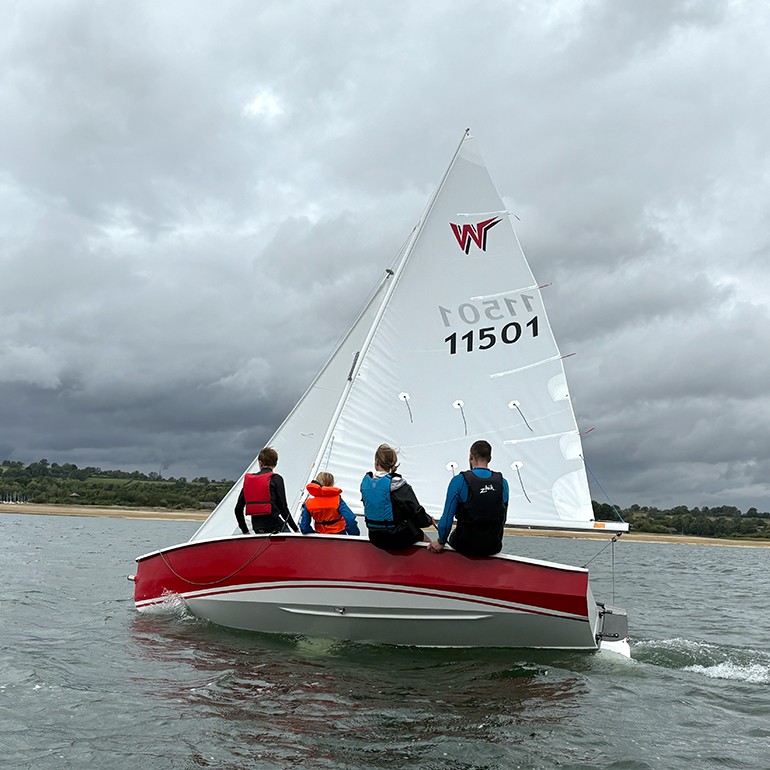
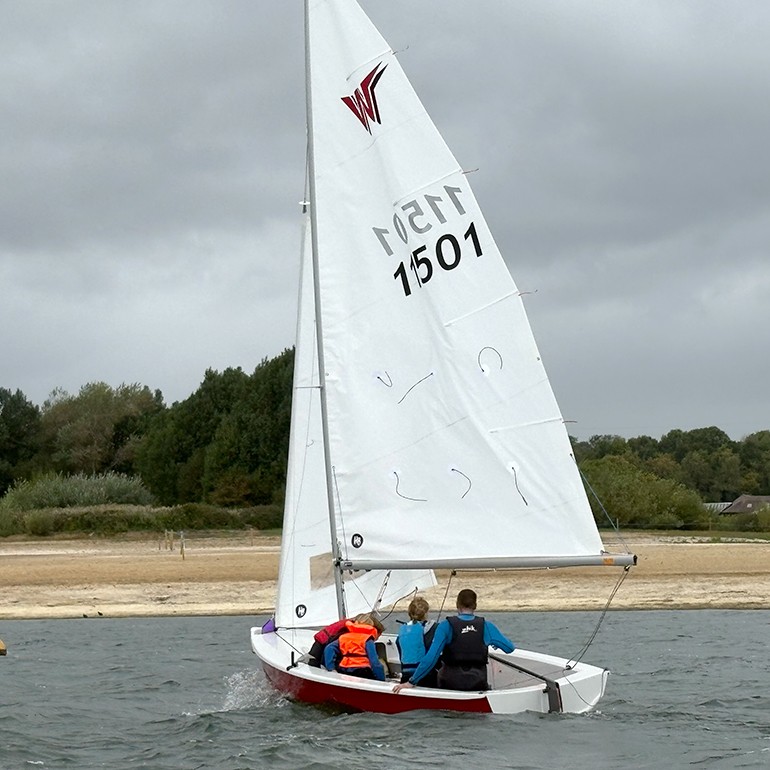
With the lake being so shallow, the commodore kindly towed us out to the deeper part of the reservoir, and the minute my hand left the side of his boat, we were off! The first thing that struck me is that it felt like a small yacht. There was very little movement as we shuffled around the boat, and though initially on a run and seated to windward, there was no sign of it wanting to come on top of us.
“If you do get it over, it will sit in the water and go head to wind. As soon as you push the sail up it will right itself,” said Mark. “But to get it to capsize, you’ve got to do something drastic. It’s incredibly stable.”
I looked at the black sky, and my family of inexperienced sailors in the RIB, just waiting to pile on board. A gust found its way down the neck of my wetsuit and I shivered. Would today be a ‘drastic’ day?
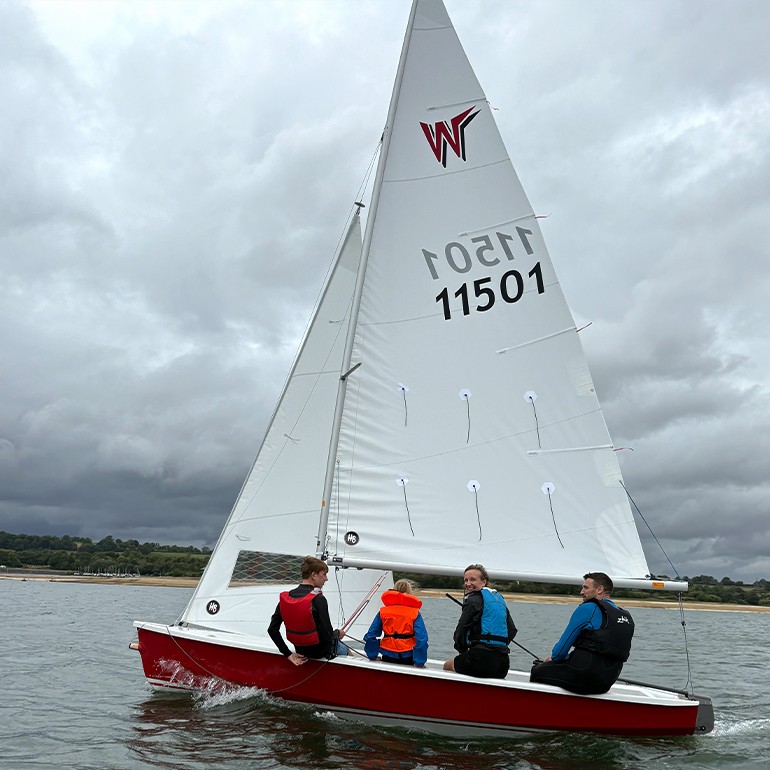
I took the helm and steered into a comfortable reach while I became familiar with the tiller extension and the roomy cockpit. The boom, half a foot higher than on previous models, was reassuringly high. Even Mark, at 6ft 6in, was in no danger of getting an accidental thunk to the head. Next, I steered upwind, shifting my weight forward to stop the back digging in and we did a series of tacks towards the reed beds and parched meadows that surrounded the lake.
On the reservoir, the wind felt more fickle than I was used to on the South Coast. As the clouds descended, I kept one eye on the gusts that rippled across the charcoal water, and the other on the tell-tales, sheeting in then loosening the jib until the front ones were horizontal and the back ones flicking up and down.
On a dinghy this size I’d have expected to be drenched by spray by now, but the motion was smooth, not bouncy, and the high freeboard kept me dry.
The squally conditions had kept most other sailors away, and our only company was a wing-kiter, who spent much of the time in the water looking like a fallen star. The rain fell heavily, and a gust caught me. I didn’t slacken the mainsheet in time, and we heeled so far over water poured in over the leeward coaming.
It was the moment in a regular dinghy that I’d be getting ready for a swim, or if I was nippy enough, a leap over the high side onto the centreboard to dry capsize. Not in the Wayfarer; she simply luffed up, flattening as we turned head to wind, and in the bottom of the boat was about 3in of water. Oops!
“Don’t worry, that’ll all go,” said Mark, unclipping the bailers from the side of the boat to give it a hand. When? I wondered, as we picked up speed. Faster, faster. Is this enough? When I finally dared take my eyes off the horizon a minute or two later, the water was gone.
Designed for cruising, the Wayfarer sits lower in the water when laden with kit. People frequently camp on board, so to keep the sole dry it was a deliberate choice not to include open drain tubes. Instead, the spring-tensioned self-bailers can be opened underway to create a venturi effect, sucking the water out of the moving boat.
You can buy a boom tent for the Wayfarer, designed by the former class chairman, and Mark tells me it’s also on the books for Hartley boats next year, which also has a chandlery at the factory.
“In the last 10 to 15 years, participation in Wayfarer dinghy cruising has skyrocketed,” he said. “There are massive rallies, and you get people circumnavigating the UK, sailing to Holland and even Greece. That said, it’s generally used for coastal and estuary cruising. Because it’s light enough to launch by hand, you can access so many venues without having to sail there.”
Reservoirs – especially half-empty ones – are not designed for lazy sailors. After our multiple tacks, and having just emptied the cockpit of water, it was time to bear away and go back downwind.
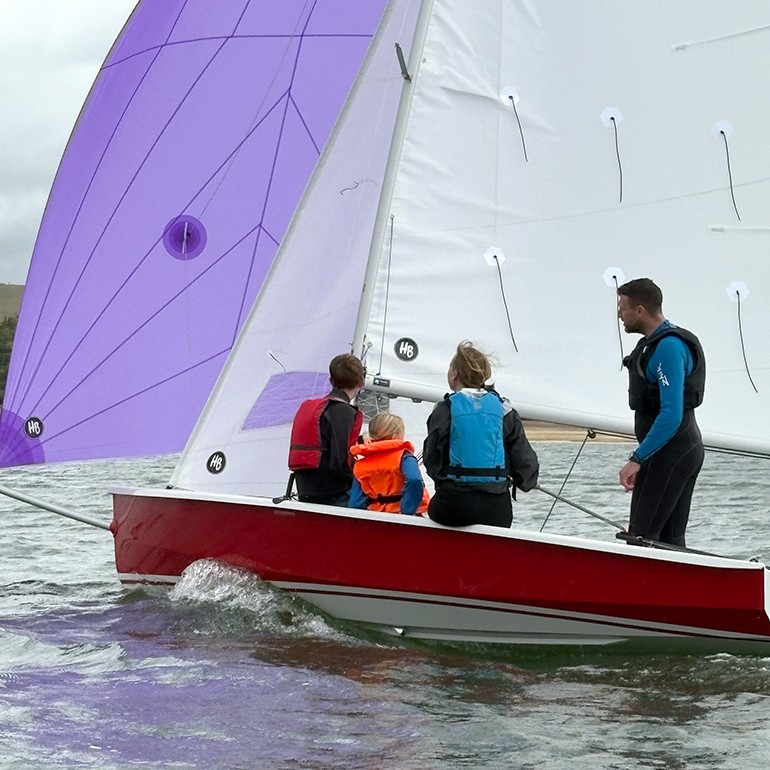
The Weekender has an asymmetric spinnaker, which works better than the older-style symmetric ones, when it comes to handling apparent wind. The spinnaker shoot is positioned in front of the forestay to make launch and recovery straightforward.
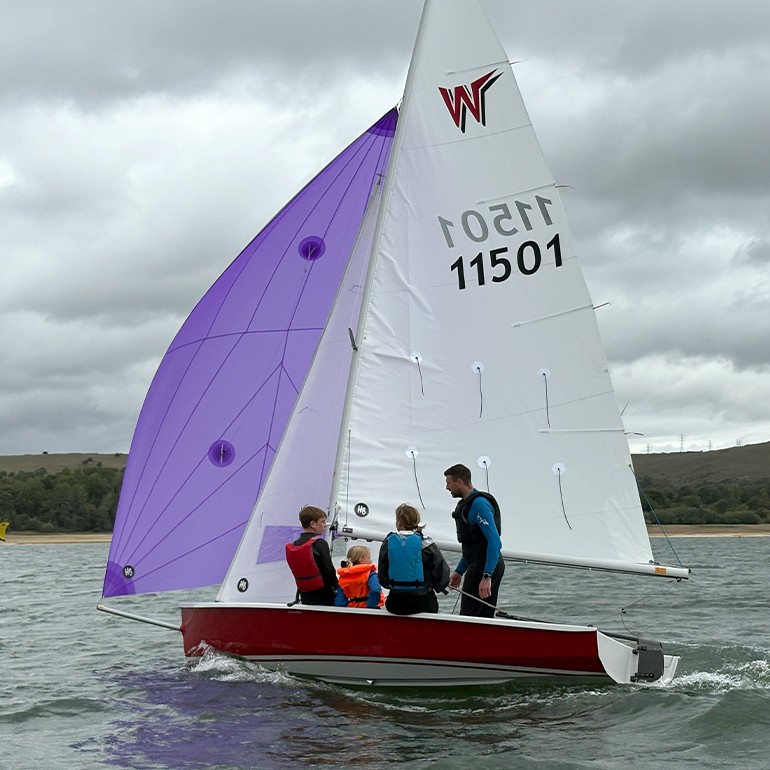
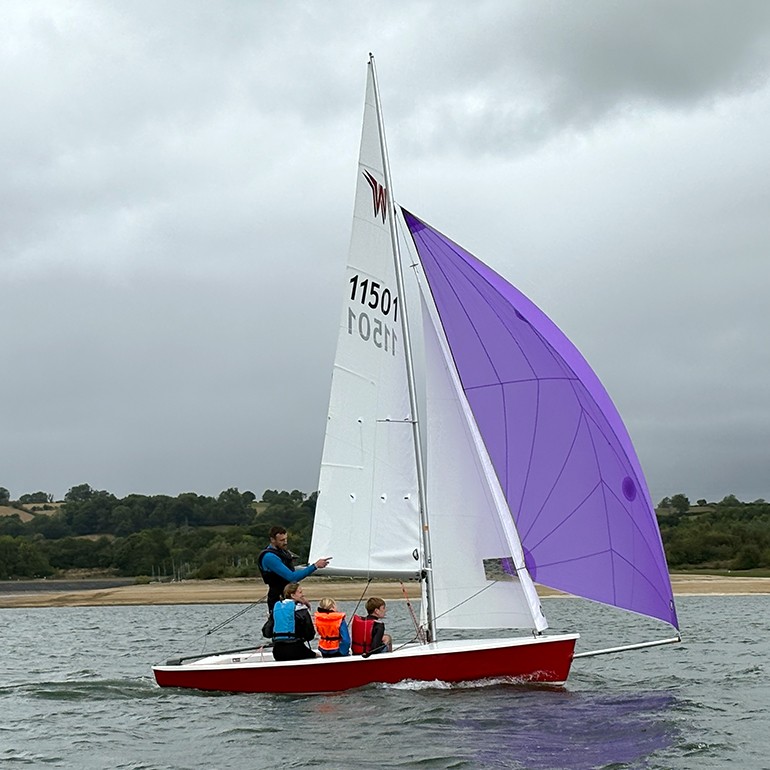
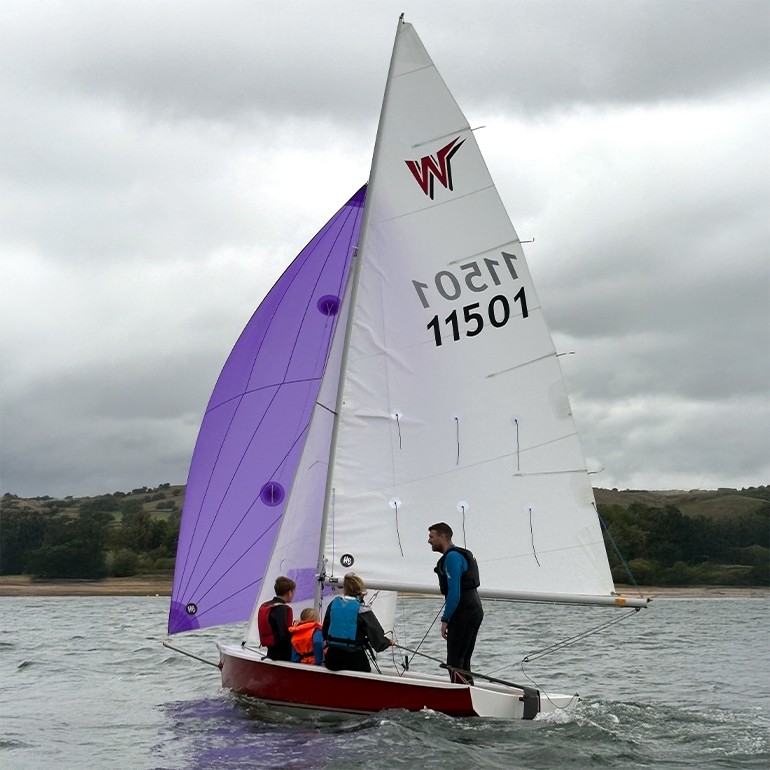
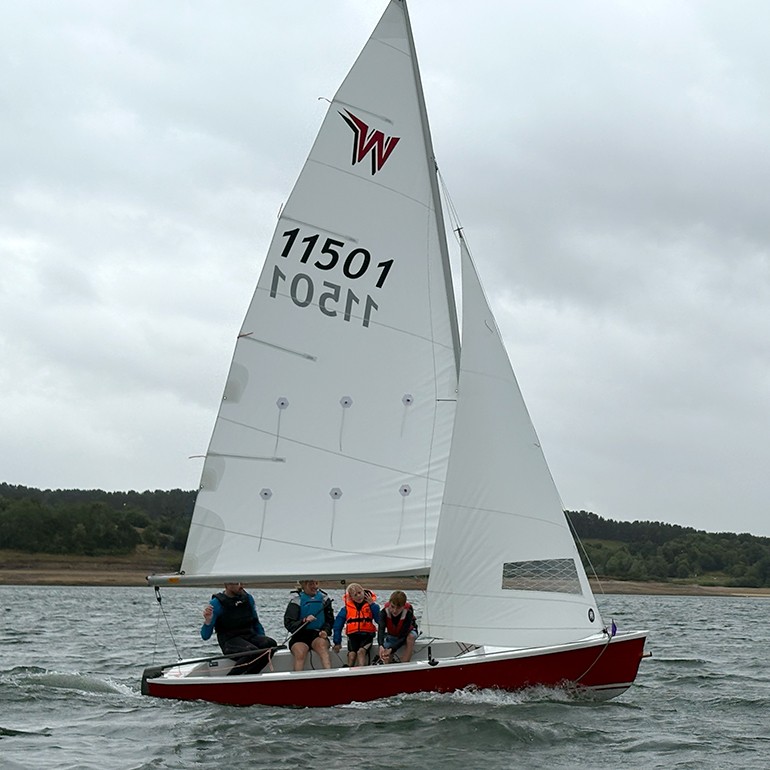
On a yacht, hoisting a spinnaker can be a two-man job, but on a Wayfarer it’s simple enough to do single-handed. In fact, it was so straightforward that when I came to switch places with my nine-year-old Fearne, she managed it too. Later my two sons and husband climbed on board (me swapping out to take photos), and the five of them flew dead downwind, surfing on waves I didn’t think were possible on a lake. This was it; surely they were going to nose-dive, or crash-gybe? But no, the Wayfarer handled them as comfortably as a yacht twice its size.
I watched proudly as they sailed on a broad reach, Fearne handling the jib with ease, and my son Brenin (14) trimming the spinnaker, looking for the curling edge to know when to sheet it on. Upwind he struggled at first to get the jib sheet in and out of the jammers but soon got the hang of it, enjoying the fact he didn’t need a winch like on a cruising boat; just muscle and a helpful luff from the helm.
Occasionally, as happens on all sailing boats, a line would get caught around a fitting, but with five on board, there was always someone to loosen it. Watching them from the RIB, as they worked as a team under Mark’s instruction – one helming, the other two working the jib sheets – was a joy. They were sailing so fast – these boats can do 16 knots on the plane – we had to give it some welly on the safety boat just to keep up!
It’s pretty hard to capsize a Wayfarer. Some owners say they’ve sailed one for 15 years and never capsized, but it is possible if you put it in a position it wouldn’t normally be; let’s say full sails in 30 knots, bearing away with the crew on the low side. While it might have been fun to try and capsize the Wayfarer Weekender, I decided it wasn’t practical given the conditions and the inexperience of the young crew.
So with big smiles all round, the kids returned to the RIB and I hopped back aboard the Wayfarer to help Mark sail her in. During the transfer, as we were head to wind, it was noticeable how steady the boat was, neither buffeted one way or another.
So what was the verdict, I asked my eldest Brenin?
“It felt a lot more stable than the other small boats I’ve sailed on, even Optimists,” he said. “Even with all that wind it didn’t feel like we were out of control, and it was MUCH more fun than Maximus [our former 28ft cruiser]!”
Fearne was in agreement, though 11-year-old Dylan, who’s always hankered after a powerboat, particularly enjoyed taking photos from the RIB.
After hot showers in the clubhouse we celebrated our successful sail in the welcoming cafe, which had views across the lake and forest beyond. As we tucked hot chocolates and pasties I was even delighted to spot a club member relaxing on the sofa with a copy of PBO!
Driving back along the Derbyshire- Cheshire border, past grassy hillocks and gritstone outcrops, I reflected on how different it had been to sail on a reservoir. All around were fern-covered footpaths leading off to the wild moors. How many sailors get views like this on their way back from the boat I wonder?
The great thing about trailer-sailing boats such as the Wayfarer is you get the overland experience as well as visiting new waters. Our weekend in Derby had been a delight, as was the sail and the drive home. For me it was just a morning, but I know that many Wayfarer owners will sail for a week or more, camping on board and waking each morning to the dawn chorus in a different creek, beach or field. For adventurers after a simple life and a good sail, the Wayfarer Weekender is the perfect family boat.